
Dental Implant Dentistry
Replace Missing Teeth With Dental Implants in Norco
Explore personalized options for replacing one tooth, several teeth, or a full arch at Hidden Valley Dental Group.
500+ 5-star reviews on Google · Serving Norco and nearby Inland Empire communities
Most PPO dental plans accepted · Financing options available
What is a dental implant?
A dental implant is a biocompatible fixture that replaces the root of a missing tooth. An abutment connects the implant to a crown, bridge, or denture that restores the visible teeth. Treatment is customized based on oral and overall health, bone support, the number and location of missing teeth, and other clinical factors.
Potential benefits
Why patients consider dental implants
Implants are one of several ways to replace missing teeth. The right choice depends on your goals, health, anatomy, maintenance needs, and treatment preferences.
Natural appearance
The visible restoration is planned to complement the size, shape, and color of nearby teeth.
Improved chewing function
Implant-supported teeth can provide stable support for eating, although function varies by restoration and individual health.
Jawbone support
An implant transfers chewing forces to the jawbone and can help maintain bone in the area where a tooth is missing.
Neighboring teeth preserved
A single implant can replace a tooth without preparing adjacent teeth for a traditional bridge.
Fixed or removable options
Implants may support a fixed crown or bridge, a fixed full arch, or a removable implant-retained denture.
Long-term potential
With appropriate planning, daily hygiene, and professional maintenance, implants can provide many years of service.
A visual overview
What is the dental implant process?
The infographic shows one common sequence and the components of an implant restoration. Your actual sequence may differ.
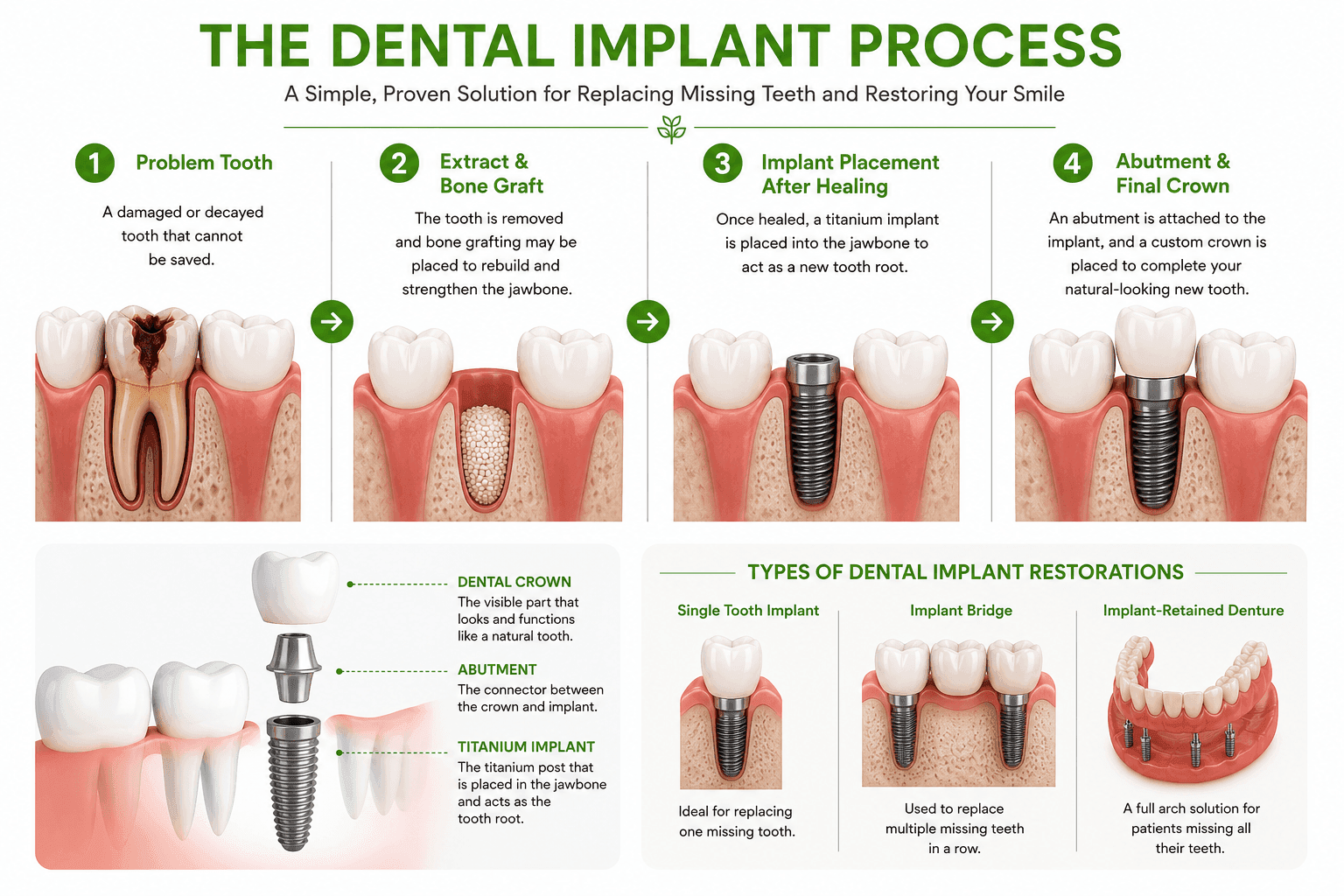
Important: Bone grafting is not needed for every patient. Some implants may be placed when a tooth is extracted, while others are placed after healing. The sequence and timing depend on the individual clinical situation.
Step by step
How the four stages fit together
Evaluating the problem tooth
Dr. Kevin Y. Kim begins with an examination and appropriate imaging. A damaged tooth may sometimes be restored rather than removed, so the first step is understanding whether saving it remains a reasonable option.
Extraction and grafting when needed
If a tooth cannot be restored, it may need to be removed. Bone grafting is considered only when the available bone and treatment plan indicate it would be helpful; it is not required for every implant patient.
Implant placement and healing
The implant fixture is positioned in the jawbone and allowed to integrate. Placement may occur at extraction or after healing, depending on the site. Healing time varies with the procedure and the individual.
Abutment and final restoration
After the implant is ready to support a tooth, an abutment connects it to the visible restoration. The final restoration may be a crown, bridge, or implant-supported denture planned for fit, function, and appearance.
Individualized scheduling
Dental implant treatment paths and timing
Not everyone follows the same schedule. These are common pathways, not fixed timelines or promises of eligibility.
Extraction, then healing
The site heals before an implant is placed. This staged approach may be recommended when the area needs time to recover.
Extraction with bone grafting
A graft may be placed to preserve or rebuild support, followed by healing and later implant placement.
Immediate implant placement
In selected situations, an implant may be placed when the tooth is removed. Examination and imaging determine whether this approach is appropriate.
Integration and restoration
After placement, the implant integrates with the bone before receiving its final crown, bridge, or denture. A temporary tooth may be possible in some cases.
Evaluation first
Who may be a candidate for dental implants?
An implant evaluation may be useful if you have one missing tooth, a badly damaged or nonrestorable tooth, several missing teeth, a failed bridge, loose or uncomfortable dentures, or interest in fixed full-arch tooth replacement.
Candidacy depends on an examination, imaging, gum health, bone support, medical history, bite forces, medications, and other individual factors. These details also help determine whether periodontal care or another preparatory service is appropriate.
Restoration options
Types of dental implant treatment
The implant fixture is the part in the jawbone, the abutment is the connector, and the restoration is the visible crown, bridge, or denture.
Single-tooth implant and crown
One implant fixture can support an individual crown without using the neighboring teeth as anchors. The crown is the visible part of the replacement tooth.
Implant-supported bridge
Strategically placed implants can support a bridge that replaces several teeth in a row. Fewer implants than missing teeth may be used, depending on the plan.
Implant-retained or implant-supported denture
Implants can improve the stability and retention of a denture. Some designs remain removable for cleaning, while other implant-supported restorations are fixed.
Full-arch and All-on-4® treatment
A full arch of replacement teeth may be supported by a planned number of implants. All-on-4® is one full-arch approach offered by HVDG, but anatomy, health, and restorative needs determine the appropriate design.
Start here
How Many Teeth Are You Replacing?
- One tooth — a single dental implant may be used to replace one missing tooth without preparing the neighboring teeth.
- Several adjacent teeth — dental implants may support a bridge across the missing-tooth area.
- Most or all teeth in an arch — full-arch implant options such as All-on-4® or All-on-6® may be considered.
The right option depends on factors such as bone support, gum health, bite, overall oral health, and treatment goals. An evaluation with Dr. Kevin Y. Kim, DDS is the starting point.
Compare the differences
Dental implants, bridges, and dentures
No single option is best for every patient. This overview can help you prepare questions for an individualized evaluation. For a closer look at the single-tooth decision, read dental implant vs. bridge.
Dental implant
- Usually fixed
- Does not require preparing neighboring teeth
- Transfers chewing forces to the jawbone
- Requires surgery, planning, and healing
- Can replace one tooth or support multiple teeth
Traditional bridge
- Fixed in place
- Supported by prepared neighboring teeth
- Does not replace the missing tooth root
- Often completed without implant surgery
- Commonly replaces one or several adjacent teeth
Removable partial denture
- Removed for cleaning
- May use nearby teeth for support or retention
- Does not replace missing tooth roots
- Can replace teeth in different areas
- Fit and maintenance needs can change over time
Full denture
- Conventional versions are removable
- Replaces a complete arch of teeth
- Rests on gum tissue without implant support
- Requires daily removal and cleaning
- Implants may be considered to improve retention
Planning your care
What affects dental implant cost?
Cost depends on the number of implants, type of final restoration, imaging and planning, bone grafting or other preparatory treatment, and sedation when appropriate. Insurance benefits vary by plan and service.
Hidden Valley Dental Group accepts most PPO plans; HMO and Medi-Cal are not accepted. Financing options include CareCredit, Alphaeon, Sunbit, and HFD / Healthcare Finance Direct. We do not quote a universal price because the treatment design must be determined first.
Review insurance and financing optionsLocal, personalized planning
Why choose Hidden Valley Dental Group?
Hidden Valley Dental Group provides implant evaluations and restorative care at our Norco, California office. Dr. Kevin Y. Kim, DDS brings more than 20 years of dental experience and earned his dental degree from Loma Linda University. He is a member of the American Dental Association, California Dental Association, and Tri-County Dental Society.
Our approach centers on clear explanations and personalized treatment planning. We serve patients from Norco, Corona, Eastvale, Jurupa Valley, Mira Loma, Riverside, and surrounding Inland Empire communities, with PPO support and financing options available.
Hidden Valley Dental Group is accepting new patients, including patients seeking an implant evaluation. Call (951) 736-8120 or book online to schedule a consultation.
Meet Dr. Kevin Y. KimCommon questions
Dental implant FAQs
What is a dental implant?
A dental implant is a biocompatible fixture placed in the jawbone to replace a missing tooth root. An abutment connects the implant to a visible crown, bridge, or implant-supported denture.
Does getting a dental implant hurt?
Local anesthetic is used to keep the treatment area numb. Comfort needs and recovery experiences vary, and our team reviews what to expect, aftercare, and appropriate sedation options before treatment.
How long does the implant process take?
There is no single timeline. The schedule depends on whether a tooth must be removed, whether grafting is needed, the condition of the bone and gums, healing, and the type of final restoration. Your plan will outline the expected stages for your situation.
Does every patient need a bone graft?
No. Bone grafting is considered when the available bone may not provide the support needed for the planned implant. Examination and imaging help determine whether it is appropriate.
Can an implant be placed immediately after extraction?
Sometimes. Immediate placement may be considered when the site, bone, gum health, and other clinical factors are favorable. Other sites benefit from healing before implant placement.
What happens while the implant heals?
The implant integrates with the surrounding bone. Depending on the location and treatment plan, a temporary tooth or removable appliance may be used. The team will explain eating, hygiene, and follow-up instructions.
Can one implant replace several teeth?
One implant does not usually support an entire multi-tooth span by itself, but a planned number of implants can support a bridge that replaces several missing teeth. The number and position depend on the span, bite, bone, and restorative design.
Are implants better than bridges?
Each option has advantages. An implant can replace a tooth without preparing neighboring teeth and can stimulate bone at the site, while a bridge may avoid implant surgery and may follow a different schedule. Oral health, anatomy, goals, and cost all matter.
How long can dental implants last?
Implants have long-term potential, but no restoration lasts forever. Longevity depends on bone and gum health, bite forces, home care, professional maintenance, medical factors, and habits such as smoking. The crown or other restoration may need repair or replacement over time.
How do I care for an implant?
Brush thoroughly, clean around and between the implant restoration as directed, and keep regular dental visits. Implants cannot develop cavities, but the surrounding gums and bone can develop inflammation or disease.
Can I get implants if I have worn dentures for years?
Possibly. Long-term denture wear can be associated with changes in jawbone volume, so examination and imaging are important. Available bone, gum health, medical history, and the desired restoration all affect the options.
Does dental insurance cover implants?
Coverage varies by plan and may apply differently to the implant, abutment, crown, grafting, or related services. HVDG accepts most PPO plans and can help review available benefits; HMO and Medi-Cal are not accepted.
What if an implant crown becomes loose or damaged?
Contact the office for an evaluation and avoid chewing on the area if it feels unstable. The issue may involve the crown, retaining screw, abutment, or implant itself. Some restorations can be repaired or replaced without replacing the integrated implant fixture.
Start with an individualized evaluation
Talk with a dental implant dentist in Norco
Call Hidden Valley Dental Group or book online to discuss your missing-tooth concerns, treatment goals, and the options that may fit your clinical needs.