
Hidden Valley Dental Group
Dental Implant vs. Bridge: Which Is Better for a Missing Tooth?

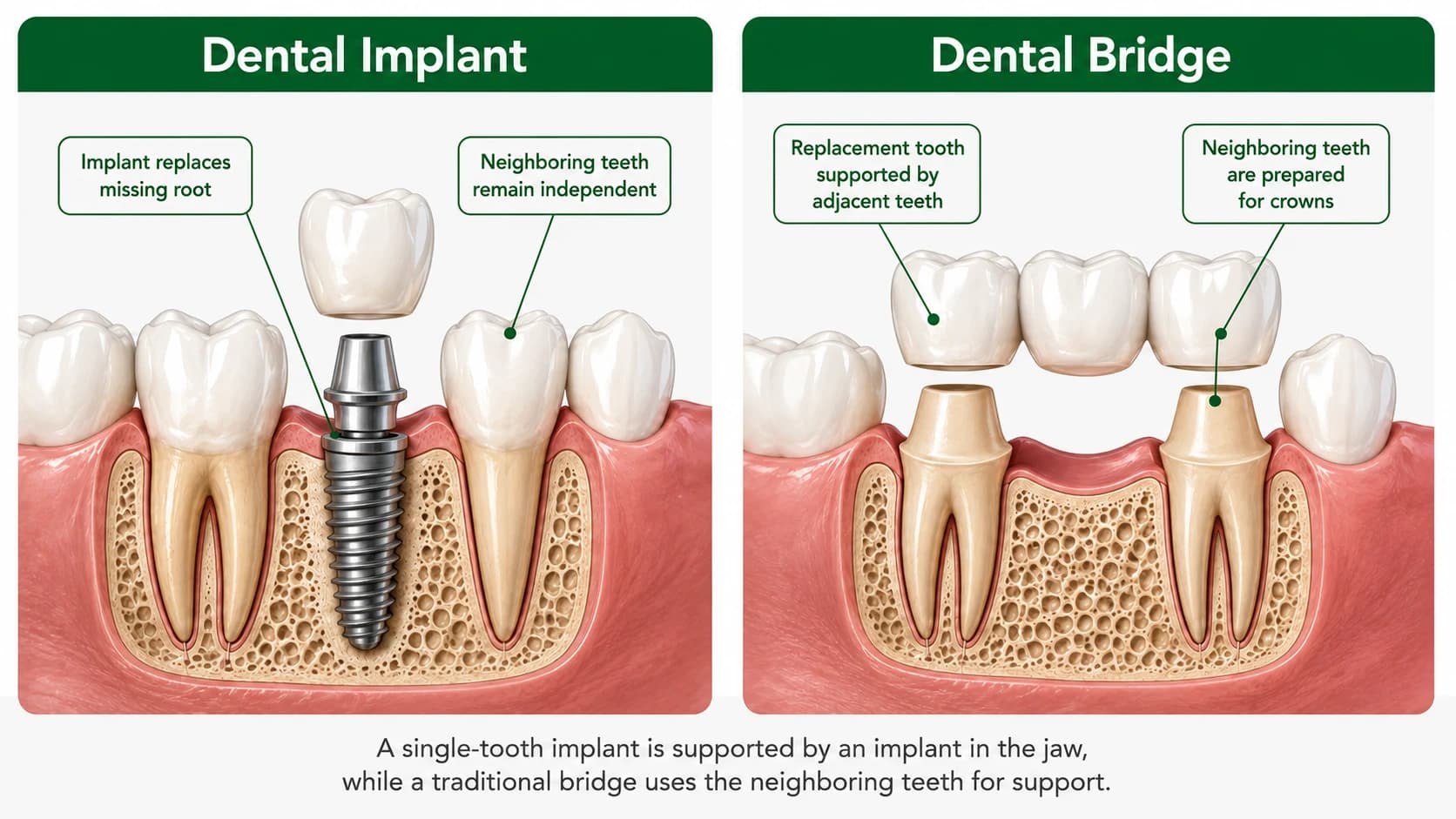
A dental implant replaces the missing tooth root and supports a crown without altering the neighboring teeth. A bridge replaces the visible tooth by anchoring to the teeth on either side, which must be prepared for crowns. Neither option is automatically better. The right choice depends on the health of the neighboring teeth, the bone and gum tissue at the site, your medical history, how long the tooth has been missing, and your own goals and timeline.
Key takeaways
- An implant replaces the tooth root; a bridge replaces only the visible tooth and relies on the neighboring teeth for support.
- Preparing a bridge means reshaping the two adjacent teeth, which cannot be undone. An implant leaves them alone.
- Bone volume, gum health, medical history, and bite forces often decide which option is realistic, not preference alone.
- Both options need daily cleaning and regular professional care. Neither lasts forever, and results vary by patient.
What each option actually is
A dental implant is a small biocompatible post placed in the jawbone to take the place of a missing tooth root. After the site has healed and the implant is stable, a connector called an abutment joins it to a crown that fills the visible gap. The neighboring teeth are not involved.
A traditional dental bridge replaces the visible tooth with an artificial tooth held in place by crowns on the teeth on either side. Those two teeth are reshaped so the crowns can fit over them. The bridge is cemented in place and is not removed for cleaning.
There are other approaches as well, including implant-supported bridges for several missing teeth in a row and removable partial dentures. This article focuses on the single-tooth decision most patients are weighing.
Dental implant vs. bridge at a glance
This overview is meant to help you prepare questions, not to decide for you. Every row can shift depending on the individual case.
| Dental implant | Traditional bridge | |
|---|---|---|
| Replaces the tooth root | Yes | No |
| Neighboring teeth | Left untouched | Reshaped for crowns |
| Surgery required | Yes | Usually no |
| Typical treatment span | Longer, with healing time between stages | Shorter, often a few visits |
| Bone at the site | Chewing forces are transferred to the bone | Bone under the gap is not stimulated |
| Daily cleaning | Brush and clean around the implant as directed | Requires cleaning under the artificial tooth |
| If a problem develops later | The crown or abutment can often be addressed separately | The whole bridge may need replacing |
Why the neighboring teeth matter so much
The single biggest difference between these options is what happens to the teeth beside the gap. A bridge requires reshaping them, and that change is permanent even if the bridge is later removed.
If those teeth are already heavily filled, cracked, or would benefit from crowns anyway, using them to support a bridge may make good sense. If they are healthy and untouched, many dentists will discuss whether an implant is a way to leave them that way.
This is a judgment call about your specific teeth, not a general rule, and it is one of the first things an evaluation looks at.
What usually decides between them
Several factors tend to shape the recommendation more than preference does:
- Bone volume and quality at the site, which an examination and imaging assess
- Gum health, since active gum disease is usually treated before implant planning
- The condition of the teeth on either side of the gap
- Medical history, medications, and habits such as smoking
- Bite forces and whether you grind or clench
- How long the tooth has been missing, since bone can change over time
- Your timeline, and how you feel about a staged treatment versus a shorter one
How long each option takes
A bridge is usually completed in a smaller number of visits over a few weeks, because there is no healing period for a surgical site.
An implant is a staged process. Depending on the case it can involve extraction, sometimes bone grafting, implant placement, a healing period while the implant integrates with the bone, and then the final restoration. There is no single timeline that applies to everyone, and your plan will outline the expected stages for your situation.
Neither option is a guaranteed lifetime solution. Longevity depends on gum and bone health, bite forces, home care, professional maintenance, medical factors, and habits. Both can need repair or replacement over time.
Who does what at Hidden Valley Dental Group
Implant treatment at our Norco office is handled in two phases by two dentists.
Dr. Eugene Kim, DDS, a prosthodontist, provides dental implant placement at Hidden Valley Dental Group on select days.
Dr. Kevin Y. Kim, DDS manages the restorative phase, including the crown or other restoration that completes the treatment. Dr. Kim is a graduate of Loma Linda University School of Dentistry with more than 20 years of experience and is a member of the American Dental Association, California Dental Association, and Tri-County Dental Society.
If a bridge turns out to be the better fit for your situation, that treatment is provided at our Norco office as well.
Cost, insurance, and financing
Cost depends on the treatment plan. For an implant it can involve imaging and planning, the placement itself, bone grafting or other preparatory treatment when needed, and the final restoration. For a bridge it depends on the number of units and the materials chosen. We do not quote a universal price, because the design has to be planned first.
Hidden Valley Dental Group accepts most PPO dental plans. Benefits vary by plan and by service, and some plans treat implants and bridges very differently. HMO plans and Medi-Cal are not accepted. Our team can help you review what your plan covers before you commit to anything.
Financing is available through CareCredit, Alphaeon, Sunbit, and Healthcare Finance Direct.
What to ask at your evaluation
Bringing questions makes the appointment more useful. A few worth asking:
- Are the teeth next to the gap healthy enough to leave alone?
- Is there enough bone for an implant, or would grafting be part of the plan?
- What would the stages and approximate timeline look like for me?
- How would each option affect cleaning and daily maintenance?
- What happens if the restoration needs repair years from now?
- How does my dental plan treat each option?
Replacing a missing tooth in Norco
Hidden Valley Dental Group is at 982 Hamner Avenue in Norco, California, and sees patients from Norco, Corona, Eastvale, Jurupa Valley, Mira Loma, and Riverside. We are accepting new patients.
If you are weighing your options, the practical next step is an examination and imaging so the recommendation is based on your actual teeth, bone, and goals rather than on general information.
Frequently asked questions
Is a dental implant better than a bridge?
Neither is automatically better. An implant replaces the tooth root and leaves the neighboring teeth untouched, while a bridge is usually completed in less time and without surgery. The right choice depends on the health of the adjacent teeth, available bone, gum health, medical history, bite forces, and your goals.
Does a bridge damage the teeth next to it?
A traditional bridge requires reshaping the teeth on either side of the gap so crowns can fit over them. That change is permanent. Whether it is a drawback depends on the condition of those teeth; if they already need crowns, the tradeoff may be smaller.
How long does each option last?
There is no guaranteed lifespan for either. Longevity depends on gum and bone health, bite forces, home care, regular professional maintenance, medical factors, and habits such as smoking or grinding. Both implants and bridges can need repair or replacement over time.
Do I need a bone graft for an implant?
Not every patient does. Grafting is considered when the available bone may not provide the support the planned implant needs. Examination and imaging help determine whether it is appropriate for your site.
Which option is faster?
A bridge is generally completed in fewer visits over a shorter period, because there is no surgical healing phase. An implant is staged and includes healing time while the implant integrates with the bone. Timelines vary by individual case.
Does dental insurance cover implants or bridges?
Coverage varies by plan and by service, and some plans treat the two options differently. Hidden Valley Dental Group accepts most PPO dental plans and can help you review available benefits before treatment. HMO plans and Medi-Cal are not accepted.
Who places and restores implants at Hidden Valley Dental Group?
Dr. Eugene Kim, DDS, a prosthodontist, provides implant placement at our Norco office on select days. Dr. Kevin Y. Kim, DDS manages the restorative phase, including the crown that completes treatment.
What if I wait and do nothing?
Leaving a gap can allow neighboring teeth to shift, may affect your bite and how you chew, and the bone under the space is no longer stimulated the way it was by the tooth root. How much this matters varies, which is why an evaluation is worthwhile even if you are undecided.
Related information
Sources and further reading
- Implants – American Dental Association, MouthHealthy
- Bridges – American Dental Association, MouthHealthy
- Crowns – American Dental Association, MouthHealthy
- Gum Disease – National Institute of Dental and Craniofacial Research
This article provides general educational information and is not a diagnosis or a substitute for an examination by a dentist. Whether an implant, a bridge, or another option is appropriate depends on the individual examination, imaging, and medical history. Treatment timing and results vary by patient.